The productivity numbers released by the U.S. Bureau of Labor Statistics in October 2006 sent a shock wave around the country: After showing robust increases for several years, productivity growth had slowed to an annualized 0.0 percent (though that was later revised up to 0.2 percent). Meanwhile, the trailing 12-month figure sat at a paltry 1.3 percent, the slowest growth since 1997.
What happened? The news of the slowdown, or near halt, to productivity growth brought with it fears that the rapid gains of the past five years were over, and that IT's contribution to productivity growth was perhaps overstated. But wasn't information technology supposed to fuel never-ending productivity increases? Isn't that why we spent all that money on the stuff?
The answer, not surprisingly, is complicated. It's so complicated, in fact, that in the ongoing debate over the impact of technology on productivity, Accenture Ltd., Microsoft Corp. and Hewlett-Packard Co. have created a new trade association dedicated to defending IT's honor. Their Institute for Innovation and Information Productivity, or IIIP, is a nonprofit group endeavoring to redefine how productivity is calculated and measured in an information-based service economy, a critical issue for technology and IT services vendors of all stripes.
Karen Lojeski, the research director for the IIIP, puts the problem in strong terms. "The way productivity is measured today just doesn't make any sense. All these productivity measures are based on manufacturing models, and there's no accurate calculation at the macro level of how to capture productivity in the service sector. And when you have an economy that's 80 percent service, you've got a problem. The idea of trying to understand it as the number of people working times the number of hours worked equals X number of widgets doesn't make any sense in a knowledge-based environment."
The questions that the IIIP is asking—and trying to answer—are ones that have vexed the business community for decades. And they are fueling a revival of the classic debate over IT productivity. What is IT's contribution to productivity? Is productivity even the proper way to measure the potential for economic growth and increases in the nation's standard of living? The answers depend on whom you ask, and on what it is you're really trying to measure. And the answers are critical, as they hold the key to understanding the true value of IT investments.
A Brief History of Productivity
As it turns out, economists attributed much of the recent slowdown to a general weakening in economic growth: When gross domestic product slows down, as it did in the third quarter of 2006, it's often accompanied by a slowdown in productivity growth, as companies anticipating further gains continue to add labor to the productivity equation without concomitant gains in output. But this time around, the fears of a productivity slowdown seemed to rattle more than a few nerves in the IT community.
The measures ordinarily used to measure productivity, such as labor productivity and even multifactor productivity, involve simply adding up all the known inputs and outputs and then doing the math. In the case of labor productivity, that's just output divided by the number of hours worked. In the case of multifactor (or total factor) productivity, that's all the known outputs divided by all the known inputs. Pretty straightforward, and it generally worked, at least as a rough measure during the Industrial Age, when the inputs and outputs were relatively easily tallied.
But the arrival of the Digital Age has exponentially exacerbated the problem. In the early days of the information revolution, when IT resided beyond the glass wall, IT's contribution to productivity was relatively easy to assess. Take the cutting of payroll checks, for instance: How many laborious hours spent writing individual checks could you eliminate by feeding payroll data into a computer that automatically calculated the amount of the check, and withholding and Social Security taxes, and then printed it? Machines replaced humans, and it was simple to see the return.
By the late 1980s, however, with the advent of personal computers, networks and back-end systems that touched more parts of the business, the math became more difficult. In 1987, Nobel Prize-winning economist Robert Solow wrote, "You can see the computer age everywhere but in the productivity statistics." The problem, analysts decided, was either a lag in the time it took for companies to benefit from their IT investments, or the difficulty of measuring IT's contribution accurately—or both.
Then came the 1990s, which brought about a transformation in IT and how businesses used it. The Internet, the graphical browser, e-commerce, as well as enterprise-level software such as ERP and CRM, brought about massive investments in computers, networking equipment and software. But all that investment only fueled the controversy surrounding just how much IT contributes to productivity gains, and whether it is accurately measured.
In 2001, McKinsey & Co.'s McKinsey Global Institute published a still-controversial report arguing that most of the productivity gains in the 1990s were attributable to just six sectors of the economy: telecom, semiconductors, computer manufacturing, securities, and wholesale and retail distribution. In other sectors productivity was essentially flat or had actually declined.
That led McKinsey to suggest that IT was just one of a number of factors that generated the decade's productivity gains. "The problem," says Diana Farrell, director of the McKinsey Global Institute, "was that all sectors of the economy spent on IT, but because the productivity gains were concentrated in just those six sectors, you clearly can't attribute the growth to IT alone." IT is needed to facilitate productivity gains, she says, but only under the right conditions, which include sufficient competitive intensity and sufficient demand—exactly the conditions faced by those six sectors that contributed so much to the productivity gains of the 1990s.
Erik Brynjolfsson, the George and Sandra Schussel Professor of Management at the MIT Sloan School of Management and director of the MIT Center for Digital Business, offers a different rationale. To explain what happened, Brynjolfsson has developed a concept he calls organizational capital:
"The work I've been doing suggests that most of the benefits from IT come from complementary investments in what we call organizational capital—business processes and other changes in the way companies are organized. For every dollar spent on IT hardware, $10 is spent on this kind of business reorganization.
"What happened in the 1990s was that companies were investing a lot, not only in IT, but also a tremendous amount in organizational capital and new business processes, and those investments tend to take several years to pay off. Go forward a few years to 2001–02, when IT spending dropped, as did investments in organizational capital. The focus was not in adding to organizational capital, but in harvesting what had been done. The way that affects productivity is that the government statistics don't measure organizational capital at all, but they do measure the output that's generated from it. So that is why we had very high productivity, circa 2001–03, as we were reaping the benefits of these investments but not incurring the expense of new investments in organizational capital," he says.
And the recent drop in productivity? Says Brynjolfsson: "If you don't invest in IT or organizational capital, then three, four, five years down the road, you're not going to be in the position to get decent returns. So five years later, 2006, that's more or less exactly what's happened: The investments that weren't made in 2001 are the reason we're not having the comparable level of productivity growth today."
IT and its Discontents
The problem with IT as a source of productivity gains is that those gains, as the McKinsey study showed, are so unevenly distributed. Put bluntly, some companies, and some sectors, are a whole lot better than others at putting IT to work productively. John Parkinson, former chief technologist for the Americas at Capgemini, points out that IT can only boost productivity if it lets you do more with less effort, or you make the time it takes to do the work shorter. But a lot of new technology innovations, he says, "imposed a productivity penalty by forcing people to relearn how they do things, which reduces their productivity for a while. That, I think, is what the McKinsey study showed: They picked a period of time, the 1990s, when lots of relearning was going on, to do the study. Everybody was disrupted by broad adoption of PCs and networks, the Internet, e-commerce. But once we figured it out, the productivity gains kicked in, because you were over the learning hump.
"The second penalty you pay, because technology makes possible things you couldn't do before, is that you now do those things because they're possible," Parkinson adds. "And that adds work to the total amount people have to do." To illustrate the problem, Parkinson points to information-based decision-making. "It used to be that managers didn't worry about gathering mountains of information, populating spreadsheets, building in the models and agonizing over what they told you. You just said, 'yeah, I think we'll go that way.' And you went. But now that process takes a lot more effort. So there's a productivity loss in some parts of business. But that doesn't mean there's an effectiveness loss. It just means that the cost of being right went up."
On a larger scale, much of the investment in IT made by corporations was simply not productive. "There was a lot of "me-too" investment in IT across a lot of sectors since 1995," says McKinsey's Farrell. "Companies saw that their rivals had something new, and so they made these very large investments without recognizing that even within a sector, different competitive strategies mean your productivity could be driven by different things. But making IT investments in areas that aren't driving the bulk of your potential productivity gains is wasted investment."
Measuring the Wrong Things
Perhaps the reason that IT has been much-maligned when it comes to productivity is that its role has been widely misunderstood. Farrell's ultimate conclusion is that considering IT a primary productivity driver isn't really accurate. Yes, it's an enabler, and even, nowadays, a necessity. But as she says, it isn't sufficient. "The real driver of productivity, before, during and after the dot-com boom, is innovation. Only innovation can drive both increases in value-add, and decreases in cost," she says. In and of itself, Farrell maintains, IT can't make a real difference. Instead, it's simply part of the process by which managers innovate—and thus drive productivity gains.
In Farrell's view, innovation begets productivity in three ways: The first involves the development of the innovation itself, whether it's a new product, service or process. The second involves how innovations get disseminated within the innovating company, or among competitors in its sectors, and eventually in other sectors. And the third is how those innovations scale to their optimum use. That's where the growth and profits come from. IT plays an increasingly critical role in this process. "In this context," she says, "one of the reasons IT is such a powerful tool is that it can enable all three of these processes. IT enables many innovations directly—mobile telephony, online securities trading and retail innovation come to mind. And it enables the diffusion of innovation much more quickly because you can replicate IT services much more quickly than you can other innovations. And finally, because IT can scale so well, it can help take innovations to their maximum potential." Still, it's not IT but the innovation that creates the competitive advantage.
Parkinson puts the problem another way. Raw productivity gains, he says, aren't sufficient to compete successfully in the 21st century. "What you want is agile productivity," he maintains. "You want to be able to repurpose the assets of your business as efficiently as possible to stay current with the market. The early 20th-century model of capital efficiency, which is what built corporations and drove the process-focused productivity of the second half of the century, is being rethought around the ability to move all assets, capital, people and information as effectively as possible." Agility, of course, is but another way to describe a kind of perpetual state of innovation, of moving fast enough—through product and process development, and into and out of markets as opportunity dictates—to compete.
That's a consistent theme among the experts and CIOs alike. Atefeh Riazi, the worldwide CIO and a senior partner at Ogilvy & Mather Worldwide, the New York City-based advertising agency, points to growth as the metric that really matters in this environment. "Cutting costs and making your people more productive is critical, of course," she says. "We have a huge mobility program in place which is going to help our people become more productive. But it goes beyond all that. Now it's whether you can get to market faster. Your competitors are coming from places you did not expect. So you have to respond faster, smarter and cheaper. All of these are going to help grow your business. It's no longer just about cutting costs."
Measuring Matters
Here's a scenario that demonstrates how the same IT investment can reap wildly different rewards. Two companies in the same industry invest in identical IT systems. The first company has both the innovative culture and the managerial wherewithal to rethink the processes affected by its new system, and revenue and earnings grow by 15 percent. The second company, with a different culture and managerial goals, concentrates on using its new system to cut staff; productivity grows by 3 percent and earnings grow by 5 percent, but revenues don't grow at all. The second company saw productivity gains from its IT investment, but the first company saw the greater benefit.
Given those two scenarios, the goal for CIOs now is to figure out how to measure the real benefit of successful innovation, and of IT's impact on the innovation process, not just the benefit of IT by itself. "In order to advance in a knowledge economy, you need to be innovating on a consistent basis," says IIIP's Lojeski. "Whether you have radical innovations, incremental innovations, process innovations, product innovations, technological innovations, administrative innovations, you need to be able to draw a straight line from the knowledge workers—and the inputs he or she makes use of, including IT—to the effectiveness of the innovation. So what we're trying to measure is the effectiveness of our output, especially when it comes to innovation and value creation. How effective are we as knowledge workers?"
If organizations could get a better handle on the true value of their knowledge-based outputs, Lojeski concludes, they would have a much better basis on which to make decisions about the inputs they use. "The overwhelming majority of executives are very frustrated with their innovation investments globally," she says. "They're reaching for all kinds of new innovation models—R&D, open innovation, outsourced innovation. But in order to face shareholders and say, 'We're providing shareholder value by investing in these kinds of things,' we have to be able to measure that value. If you can't measure what you're doing accurately, it's very difficult to value your investments accurately.
"We don't have the answers yet," Lojeski adds. "But we're thinking that, ultimately, effectiveness will replace productivity as the standard measure of growth for the knowledge economy."
http://www.cioinsight.com/article2/0,1540,2085007,00.asp
Monday, February 05, 2007

Friday, February 02, 2007
Performance Evaluations
How did you do in your last performance review ? These quotes were taken from actual performance evaluations, I’m not sure if those being evaluated still had jobs at the end of it…
1. “Since my last report, this employee has reached rock bottom-and has started to dig.”
2. “His men would follow him anywhere-but only out of morbid curiosity.”
3. “I would not allow this employee to breed.”
4. “This employee is really not so much of a ‘has-been’, but more of a definite ‘won’t be’.”
5. “Works well when under constant supervision and cornered like a rat in a trap.”
6. “When she opens her mouth, it seems that it is only to change feet.”
7. “He would be out of his depth in a parking lot puddle”
8. “This young lady has delusions of adequacy.”
9. “He sets low personal standards and then consistently fails to achieve them.”
10. “This employee is depriving a village somewhere of an idiot.”
11. “This employee should go far, ….. and the sooner he starts, the better.”
12. “Got a full 6-pack, but lacks the plastic thing to hold it all together.”
13. “A gross ignoramus - 144 times worse than an ordinary ignoramus.”
14. “He certainly takes a long time to make his pointless.”
15. “He doesn’t have ulcers, but he’s a carrier.”
16. “I would like to go hunting with him sometime.”
17. “He’s been working with glue too much.”
18. “He would argue with a sign post.”
19. “He has a knack for making strangers immediately.”
20. “He brings a lot of joy whenever he leaves the room.”
21. “When his IQ reaches 50, he should sell.”
22. “If you see two people talking and one looks bored-he’s the other one.”
23. “A photographic memory but with the lens cover glued on.”
24. “A prime candidate for natural de-selection.”
25. “Donated his brain to science before he was done using it.”
26. “Gates are down, the lights are flashing, but the train isn’t coming.”
27. “Has two brains: one is lost and the other is out looking for it.”
28. “If he were any more stupid, he’d have to be watered twice a week.
29. “If you give him a penny for his thoughts, you’d get change.”
30. “If you stand close enough to him, you can hear the oceans
31. “He’s so dense, light bends around him.”
32. “One neuron short of a synapse.”
33. “Some drink from the fountain of knowledge;….. he only gargled.”
34. “Takes him 2 hours to watch 60 minutes.”
35. “The wheel is turning, but the hamster is dead.”
1. “Since my last report, this employee has reached rock bottom-and has started to dig.”
2. “His men would follow him anywhere-but only out of morbid curiosity.”
3. “I would not allow this employee to breed.”
4. “This employee is really not so much of a ‘has-been’, but more of a definite ‘won’t be’.”
5. “Works well when under constant supervision and cornered like a rat in a trap.”
6. “When she opens her mouth, it seems that it is only to change feet.”
7. “He would be out of his depth in a parking lot puddle”
8. “This young lady has delusions of adequacy.”
9. “He sets low personal standards and then consistently fails to achieve them.”
10. “This employee is depriving a village somewhere of an idiot.”
11. “This employee should go far, ….. and the sooner he starts, the better.”
12. “Got a full 6-pack, but lacks the plastic thing to hold it all together.”
13. “A gross ignoramus - 144 times worse than an ordinary ignoramus.”
14. “He certainly takes a long time to make his pointless.”
15. “He doesn’t have ulcers, but he’s a carrier.”
16. “I would like to go hunting with him sometime.”
17. “He’s been working with glue too much.”
18. “He would argue with a sign post.”
19. “He has a knack for making strangers immediately.”
20. “He brings a lot of joy whenever he leaves the room.”
21. “When his IQ reaches 50, he should sell.”
22. “If you see two people talking and one looks bored-he’s the other one.”
23. “A photographic memory but with the lens cover glued on.”
24. “A prime candidate for natural de-selection.”
25. “Donated his brain to science before he was done using it.”
26. “Gates are down, the lights are flashing, but the train isn’t coming.”
27. “Has two brains: one is lost and the other is out looking for it.”
28. “If he were any more stupid, he’d have to be watered twice a week.
29. “If you give him a penny for his thoughts, you’d get change.”
30. “If you stand close enough to him, you can hear the oceans
31. “He’s so dense, light bends around him.”
32. “One neuron short of a synapse.”
33. “Some drink from the fountain of knowledge;….. he only gargled.”
34. “Takes him 2 hours to watch 60 minutes.”
35. “The wheel is turning, but the hamster is dead.”
Monday, January 22, 2007
Big Brother row points to mature India
White English people are ignorant stupid racists.
It's a sweeping, inaccurate generalisation but it's the impression that might have been left in the minds of millions of people in India who last week watched one of their own being, to use the English vernacular, "slagged off" mercilessly on British TV.
Contrary to much of the reporting around the world Shilpa Shetty is not a major Bollywood star. If she was she would not have shared a stage with the British B-grade celebrities also stuck inside the Big Brother House.
The programme makers wouldn't have been able to afford her pay cheque. But while she may not have been the darling of the big screen in India before she entered the reality show, she'll emerge, regardless of the means of her exit as a darling of the Indian middle class.
Onslaught
There has been a palpable sense of pride with the way she has dealt with what is widely seen here as racist, foul-mouthed onslaughts from her clearly under-educated, boorish English companions.
Ms Goody articulates in all her crassness the fact that your average English speaking Indian is a lot better educated than your average English person
Send your comments
But more interestingly the incident has also shown that India, contrary to the fears of British diplomats, has become comfortable enough with its position in the world to see things like the Big Brother row in perspective.
The Indian media has had a feeding frenzy on this story. It's dominated the headlines and been wall-to-wall across the dozens of new TV news channels that have sprung up over the last few years.
What there hasn't been is a knee jerk xenophobia against the British, in response to an Indian woman being abused by descendants of the old Raj.
For many years India had a real chip on its shoulder about the UK. The injustices of the colonial era were never far from the surface. Given an opportunity Indian leaders would fall over themselves to take a dig at the British for an easy bit of popular press.
The best example of this was when the then Prime Minister IK Gujral publicly called the UK a "third rate" country in petulant response to a perceived slight from the British entourage out for the 50th anniversary of India's independence.
Future greatness
I'm sure that if the Big Brother controversy had been played out then, the reaction of the Indian media would have been much more akin to the kind of aggressive nationalism displayed by the British tabloids against the French.
But as India this year prepares to celebrate its 60th anniversary of independent rule one thing seems to be clear.
India has stopped looking over its shoulder. It no longer views itself through the prism of its colonial past.
The "Britishers" are no longer the bogeymen they used to be because India is no longer suffering from the inferiority complex it used to have. India no longer feels the need to dwell on past injustices because it's too busy getting ready for what many predict will be its future greatness.
There has been outrage here at the treatment of Shilpa Shetty. But there has also been acknowledgement that there has been equal outrage in the UK from brown, black and white people alike.
The condemnation by Britain's political class from the prime minister down has received the same attention as the comments from the Indian government. The only exception to this measured response were the half dozen chaps in Bihar who found their 15 minutes of fame by burning a rather bad effigy of the Channel Four executives.
But no-one in India is going to claim that the actions of a few underemployed Biharis, which was recycled endlessly on TV around the world, represents the rest of the nation.
So despite the shrill cry from the British media, there was never any chance that this was going to become a diplomatic incident during the visit of Britain's finance minister, Gordon Brown.
His entourage were probably having kittens when the media started asking him about this story but the reality is that today's Indian leadership is much more interested in solidifying its place in the international pecking order than scoring cheap points off the likely next British prime minister.
Better educated
One English commentator noted after the row erupted that "Shilpa Shetty has taken the supposed British virtues of civility, articulacy, reserve and having a stiff upper lip and shown that.. we lack them".
That's not all India does better than the UK these days. In terms of their celebrity status Shilpa and her nemesis Jade Goody are almost on a par.
But taken as a snap shot of like-for-like India's B-grade celebrities are clearly better educated, better mannered and frankly speak better English than their UK counterparts.
'Ms Goody has earned the ire of many in the UK for trashing its reputation across the world.
Unfortunately for the UK it's not just Indian celebrities. British companies have been outsourcing their customer service centres, software departments, biotechnology labs etc to the subcontinent for years now.
They did so because they recognised a huge pool of well-educated, English-speaking, middle-class people that could do the job not only cheaper than the folks back home, but often better.
Jade Goody clearly believed that her behaviour would be tolerated by the British public watching outside. She was wrong.
Ms Goody has earned the ire of many in the UK for trashing its reputation across the world. Her antics also over-shadowed Mr Brown's trip here.
But long term she may have helped Mr Brown make a fairly important point to the British public.
Gordon Brown had never set foot in India before last week. But he already knew the challenges its huge pool of young people posed to the UK economy. He outlined the challenges in his annual economic review late last year.
Ms Goody articulates in her crassness the fact that your average English-speaking Indian (most of whom have been through private schooling) is a lot better educated than your average English person. And by the way there are probably more than 100 million of them.
If you're British then Shilpa Shetty in all her well-mannered educated politeness is a lot more scary that Jade Goody could ever hope to be.
http://news.bbc.co.uk/2/hi/south_asia/6285717.stm
It's a sweeping, inaccurate generalisation but it's the impression that might have been left in the minds of millions of people in India who last week watched one of their own being, to use the English vernacular, "slagged off" mercilessly on British TV.
Contrary to much of the reporting around the world Shilpa Shetty is not a major Bollywood star. If she was she would not have shared a stage with the British B-grade celebrities also stuck inside the Big Brother House.
The programme makers wouldn't have been able to afford her pay cheque. But while she may not have been the darling of the big screen in India before she entered the reality show, she'll emerge, regardless of the means of her exit as a darling of the Indian middle class.
Onslaught
There has been a palpable sense of pride with the way she has dealt with what is widely seen here as racist, foul-mouthed onslaughts from her clearly under-educated, boorish English companions.
Ms Goody articulates in all her crassness the fact that your average English speaking Indian is a lot better educated than your average English person
Send your comments
But more interestingly the incident has also shown that India, contrary to the fears of British diplomats, has become comfortable enough with its position in the world to see things like the Big Brother row in perspective.
The Indian media has had a feeding frenzy on this story. It's dominated the headlines and been wall-to-wall across the dozens of new TV news channels that have sprung up over the last few years.
What there hasn't been is a knee jerk xenophobia against the British, in response to an Indian woman being abused by descendants of the old Raj.
For many years India had a real chip on its shoulder about the UK. The injustices of the colonial era were never far from the surface. Given an opportunity Indian leaders would fall over themselves to take a dig at the British for an easy bit of popular press.
The best example of this was when the then Prime Minister IK Gujral publicly called the UK a "third rate" country in petulant response to a perceived slight from the British entourage out for the 50th anniversary of India's independence.
Future greatness
I'm sure that if the Big Brother controversy had been played out then, the reaction of the Indian media would have been much more akin to the kind of aggressive nationalism displayed by the British tabloids against the French.
But as India this year prepares to celebrate its 60th anniversary of independent rule one thing seems to be clear.
India has stopped looking over its shoulder. It no longer views itself through the prism of its colonial past.
The "Britishers" are no longer the bogeymen they used to be because India is no longer suffering from the inferiority complex it used to have. India no longer feels the need to dwell on past injustices because it's too busy getting ready for what many predict will be its future greatness.
There has been outrage here at the treatment of Shilpa Shetty. But there has also been acknowledgement that there has been equal outrage in the UK from brown, black and white people alike.
The condemnation by Britain's political class from the prime minister down has received the same attention as the comments from the Indian government. The only exception to this measured response were the half dozen chaps in Bihar who found their 15 minutes of fame by burning a rather bad effigy of the Channel Four executives.
But no-one in India is going to claim that the actions of a few underemployed Biharis, which was recycled endlessly on TV around the world, represents the rest of the nation.
So despite the shrill cry from the British media, there was never any chance that this was going to become a diplomatic incident during the visit of Britain's finance minister, Gordon Brown.
His entourage were probably having kittens when the media started asking him about this story but the reality is that today's Indian leadership is much more interested in solidifying its place in the international pecking order than scoring cheap points off the likely next British prime minister.
Better educated
One English commentator noted after the row erupted that "Shilpa Shetty has taken the supposed British virtues of civility, articulacy, reserve and having a stiff upper lip and shown that.. we lack them".
That's not all India does better than the UK these days. In terms of their celebrity status Shilpa and her nemesis Jade Goody are almost on a par.
But taken as a snap shot of like-for-like India's B-grade celebrities are clearly better educated, better mannered and frankly speak better English than their UK counterparts.
'Ms Goody has earned the ire of many in the UK for trashing its reputation across the world.
Unfortunately for the UK it's not just Indian celebrities. British companies have been outsourcing their customer service centres, software departments, biotechnology labs etc to the subcontinent for years now.
They did so because they recognised a huge pool of well-educated, English-speaking, middle-class people that could do the job not only cheaper than the folks back home, but often better.
Jade Goody clearly believed that her behaviour would be tolerated by the British public watching outside. She was wrong.
Ms Goody has earned the ire of many in the UK for trashing its reputation across the world. Her antics also over-shadowed Mr Brown's trip here.
But long term she may have helped Mr Brown make a fairly important point to the British public.
Gordon Brown had never set foot in India before last week. But he already knew the challenges its huge pool of young people posed to the UK economy. He outlined the challenges in his annual economic review late last year.
Ms Goody articulates in her crassness the fact that your average English-speaking Indian (most of whom have been through private schooling) is a lot better educated than your average English person. And by the way there are probably more than 100 million of them.
If you're British then Shilpa Shetty in all her well-mannered educated politeness is a lot more scary that Jade Goody could ever hope to be.
http://news.bbc.co.uk/2/hi/south_asia/6285717.stm
Thursday, January 18, 2007
Qwerty Attacks!
Coming back to the adventures of our fearless IT hero, Qwerty, the quintessential IT geek, who has a trick or two up his sleeve in solving a problem.
It was a bright and sunny morning, our fearless hero strolls slowly to the meeting point, where the transport usually picks up him along with his fellow workers to take them to work. On the way, our hero thinks, suddenly he realises, oh my gosh! i forgot to add the code!
HE FORGOT TO ADD THE CODE! HE FORGOT TO ADD THE CODE! HE FORGOT TO ADD THE CODE!!!!
ding!!ding!!ding!!ding!!ding!!ding!!ding!!ding!!ding!! the bells suddenly start clanging away! WHAT did he do, he actually forgot! the deliverable was last night, and he realised that this was a mistake he is going to regret.
cursing his luck , Qwerty runs to the stop. realises its a futile attempt, as the transport would not come a minute before its designated time. he started walking fast to the point. all along the way, he was thingking. what must i do?
What was the code? what is that one thing that Qwerty forgot to add, the perfect programmer who people claim is the best, actually forgot something. Gwash! what is the world coming to with peopel forgetting things. well, the transport finallyshows its ugly head over the bridge, why... he asks himself, "can they not change this ugly transport" sometiems i think to myself, this transport is so vile, that it does not know if its coming or going. This is because of the fact that tht same piece of glass design covers the front as well as theback of the vehicle.
he clambers on, dreading the fact that his project manager would have reached before him, and that he would have realised that Qwerty has not DONE it! a cold sweat breaks out, and his stomach goes into knots. Hi co-worker asks if all is ok, but Qwerty does not answer, thinmking what is the point. this is my last day on the bus anyway!
Painfully, counting the minutes, like the prisioner an hour before his execution, a feeling of helplessness comes over, its like you have fallen into a cold pool, and have no way of getting out, you wonder,... what next? aaaarrrhhhhggggg!!!
YOU'RE FIRED!YOU'RE FIRED!YOU'RE FIRED!YOU'RE FIRED!YOU'RE FIRED!YOU'RE FIRED!YOU'RE FIRED!!!! The words resonate in Qwertys head. Oh, my GOD! today is going to be the very last day. what o i do?
the thoughts are broken with the sharp piercing of the beeper suggesting that they had arrived at their destination. now, his whole back is drenched in sweat, wondering how on earth is he going to get thru this?
slowly, he trdges along, unwillingly, to his desk, left, right, left, right, left, right, left, right, left, right till he reaches the building. clomping his way up to his floor, he goes to the desk and sits down. turns on the monitor, his face going ashen with every second.
slowly he looks at his inbox.... a moment of silence........................................................................................................................... ........................................................................................................................................................................ ........................................................................................................................................................................ ........................................................................................................................................................................ ................... and color first drains..... he sees a mail..... oh my god!
he opens the mail.... wondering what can possibly go wrong....... he blinks... wonders ..........................is he really reading this? it all looks so surreal.... a smile breaks on the corner of his mouth, slowly spreads across the face.... he stops himself from jumping up.
"QWERTY!" his boss hollers....." get your behind here..... "
why the hell did you forget to fill your time sheet..... all the time staring at the computer screen... before he has a chance to defend himself, his boss looks up.... "get outa my sight".
Our hero goes, sits at his desk... and reads the mail again.......
"The ERP system will be down for maintenance tonight, you will find it difficult to fill your time sheets, and hence we request you to fill in your time sheets tomorrow"
Long live!
It was a bright and sunny morning, our fearless hero strolls slowly to the meeting point, where the transport usually picks up him along with his fellow workers to take them to work. On the way, our hero thinks, suddenly he realises, oh my gosh! i forgot to add the code!
HE FORGOT TO ADD THE CODE! HE FORGOT TO ADD THE CODE! HE FORGOT TO ADD THE CODE!!!!
ding!!ding!!ding!!ding!!ding!!ding!!ding!!ding!!ding!! the bells suddenly start clanging away! WHAT did he do, he actually forgot! the deliverable was last night, and he realised that this was a mistake he is going to regret.
cursing his luck , Qwerty runs to the stop. realises its a futile attempt, as the transport would not come a minute before its designated time. he started walking fast to the point. all along the way, he was thingking. what must i do?
What was the code? what is that one thing that Qwerty forgot to add, the perfect programmer who people claim is the best, actually forgot something. Gwash! what is the world coming to with peopel forgetting things. well, the transport finallyshows its ugly head over the bridge, why... he asks himself, "can they not change this ugly transport" sometiems i think to myself, this transport is so vile, that it does not know if its coming or going. This is because of the fact that tht same piece of glass design covers the front as well as theback of the vehicle.
he clambers on, dreading the fact that his project manager would have reached before him, and that he would have realised that Qwerty has not DONE it! a cold sweat breaks out, and his stomach goes into knots. Hi co-worker asks if all is ok, but Qwerty does not answer, thinmking what is the point. this is my last day on the bus anyway!
Painfully, counting the minutes, like the prisioner an hour before his execution, a feeling of helplessness comes over, its like you have fallen into a cold pool, and have no way of getting out, you wonder,... what next? aaaarrrhhhhggggg!!!
YOU'RE FIRED!YOU'RE FIRED!YOU'RE FIRED!YOU'RE FIRED!YOU'RE FIRED!YOU'RE FIRED!YOU'RE FIRED!!!! The words resonate in Qwertys head. Oh, my GOD! today is going to be the very last day. what o i do?
the thoughts are broken with the sharp piercing of the beeper suggesting that they had arrived at their destination. now, his whole back is drenched in sweat, wondering how on earth is he going to get thru this?
slowly, he trdges along, unwillingly, to his desk, left, right, left, right, left, right, left, right, left, right till he reaches the building. clomping his way up to his floor, he goes to the desk and sits down. turns on the monitor, his face going ashen with every second.
slowly he looks at his inbox.... a moment of silence........................................................................................................................... ........................................................................................................................................................................ ........................................................................................................................................................................ ........................................................................................................................................................................ ................... and color first drains..... he sees a mail..... oh my god!
he opens the mail.... wondering what can possibly go wrong....... he blinks... wonders ..........................is he really reading this? it all looks so surreal.... a smile breaks on the corner of his mouth, slowly spreads across the face.... he stops himself from jumping up.
"QWERTY!" his boss hollers....." get your behind here..... "
why the hell did you forget to fill your time sheet..... all the time staring at the computer screen... before he has a chance to defend himself, his boss looks up.... "get outa my sight".
Our hero goes, sits at his desk... and reads the mail again.......
"The ERP system will be down for maintenance tonight, you will find it difficult to fill your time sheets, and hence we request you to fill in your time sheets tomorrow"
Long live!
Wednesday, January 17, 2007
aaah... the world we live in!
I was just reading a wiki on how to make " starship enterprise" from a floppy drive. The pictures clearly depict the complete destruction of a floppy disk to create the greatest spaceship of all times, evidently, I am a huge startrek fan! anyways, so what do i read at the end of the wiki....
 back in the floppy drive.
Whom do you blame for the reducing IQ in the world?
Warnings
- The edges of the metal dust cover and disk hub are extremely sharp. You can cut yourself on them, so be careful.
- Doing this will destroy all data on the disk.
- Do not attempt to place your new model into a floppy disk drive.
 back in the floppy drive.
Whom do you blame for the reducing IQ in the world?
Monday, January 08, 2007
Untitled!
For almost a decade I have been taking a train to kerala, where I used to go to met my grand-parents. I used to always be excited. I don't know whether it was the excitment of eating the train food or the various sounds and smells that overcomes one orifactory senses all along, or the taste buds that are tingled at various points of the way. My train journeys used to terminate at Kochi. the hub-bub city mixed with the traditional gaiety of rural life. I used to spend some time with my paternal grand parents and then move on to meeet my maternal grandparents. I used to look forward to this bus journey as well. I used to wonder if I would eat something on the way. the problem was I used to always put my stomach before me. Many years ago, my maternal grandparents passed awaay. I was feeling bad the entire week, and finally I wondered if I would ever travel that way again. Two years ago, a friend of mine and I were enroute to munnar from Kochi. The bus took the same route as it always took, national highway, turned right, turned left, went straight, etc. etc.... it was thn that I saw far away and noticed the far hills washed green with grass, embedded with golden coloured rocks, the lush green carpet of growing rice fields, welcoming me, the chirping of birds and insects, singing my song, th gurgle and the roar of the periyar river.
It was then, when it all made sense, I had seen the scenery more than a hundred times, but on that day in april, on that bus, I noticed it, and it was on that day I truly missed my grandparents.
________________________
I found this piece that I had writen tucked away somwehere, and decided to blog it!
It was then, when it all made sense, I had seen the scenery more than a hundred times, but on that day in april, on that bus, I noticed it, and it was on that day I truly missed my grandparents.
________________________
I found this piece that I had writen tucked away somwehere, and decided to blog it!
Friday, December 15, 2006
100 things we didn't know this time last year
A rather interesting read! did not know such a thing even existed.
 10 beach huts by Angela Pini |
1. The UK's first mobile phone call was made 20 years ago this year, when Ernie Wise rang the Vodafone head office, which was then above a curry shop in Newbury.
2. Mohammed is now one of the 20 most popular names for boys born in England and Wales.
3. While it's an offence to drop litter on the pavement, it's not an offence to throw it over someone's garden wall.
 10 toes by Stuart Evans


4. An average record shop needs to sell at least two copies of a CD per year to make it worth stocking, according to Wired magazine.
5. Nicole Kidman is scared of butterflies. "I jump out of planes, I could be covered in cockroaches, I do all sorts of things, but I just don't like the feel of butterflies' bodies," she says.
6. WD-40 dissolves cocaine - it has been used by a pub landlord to prevent drug-taking in his pub's toilets.
7. Baboons can tell the difference between English and French. Zoo keepers at Port Lympne wild animal park in Kent are having to learn French to communicate with the baboons which had been transferred from Paris zoo.
8. Devout Orthodox Jews are three times as likely to jaywalk as other people, according to an Israeli survey reported in the New Scientist. The researchers say it's possibly because religious people have less fear of death.
9. The energy used to build an average Victorian terrace house would be enough to send a car round the Earth five times, says English Heritage.
10. Humans can be born suffering from a rare condition known as "sirenomelia" or "mermaid syndrome", in which the legs are fused together to resemble the tail of a fish.  10 butterfly eggs by Peter Rettenberger
11. One in 10 Europeans is allegedly conceived in an Ikea bed.
12. Until the 1940s rhubarb was considered a vegetable. It became a fruit when US customs officials, baffled by the foreign food, decided it should be classified according to the way it was eaten.
13. Prince Charles broke with an 80-year tradition by giving Camilla Parker Bowles a wedding ring fashioned from Cornish gold, instead of the nugget of Welsh gold that has provided rings for all royal brides and grooms since 1923.
14. It's possible for a human to blow up balloons via the ear. A 55-year-old factory worker from China reportedly discovered 20 years ago that air leaked from his ears, and he can now inflate balloons and blow out candles.
15. Lionesses like their males to be deep brunettes.
16. The London borough of Westminster has an average of 20 pieces of chewing gum for every square metre of pavement.
17. Bosses at Madame Tussauds spent £10,000 separating the models of Brad Pitt and Jennifer Aniston when they separated. It was the first time the museum had two people's waxworks joined together.
18. If all the Smarties eaten in one year were laid end to end it would equal almost 63,380 miles, more than two-and-a-half times around the Earth's equator.
19. The = sign was invented by 16th Century Welsh mathematician Robert Recorde, who was fed up with writing "is equal to" in his equations. He chose the two lines because "noe 2 thynges can be moare equalle".
20. The Queen has never been on a computer, she told Bill Gates as she awarded him an honorary knighthood.  10 on Ford GT40 by Tony Crowther
21. One person in four has had their identity stolen or knows someone who has.
22. The length of a man's fingers can reveal how physically aggressive he is, scientists say.
23. In America it's possible to subpoena a dog.
24. The 71m packets of biscuits sold annually by United Biscuits, owner of McVitie's, generate 127.8 tonnes of crumbs.
25. Nelson probably had a broad Norfolk accent.
26. One in four people does not know 192, the old number for directory inquiries in the UK, has been abolished.
27. Only in France and California are under 18s banned from using sunbeds.
28. The British buy the most compact discs in the world - an average of 3.2 per year, compared to 2.8 in the US and 2.1 in France.
29. When faced with danger, the octopus can wrap six of its legs around its head to disguise itself as a fallen coconut shell and escape by walking backwards on the other two legs, scientists discovered.
30. There are an estimated 1,000 people in the UK in a persistent vegetative state.  10 hangers by Patrick McGarry
31. Train passengers in the UK waited a total of 11.5m minutes in 2004 for delayed services.
32. "Restaurant" is the most mis-spelled word in search engines.
33. Chelsea boss Jose Mourinho has only been in an English pub once, to buy his wife cigarettes.
34. The Little Britain wheelchair sketch with Lou and Andy was inspired by Lou Reed and Andy Warhol.
35. The name Lego came from two Danish words "leg godt", meaning "play well". It also means "I put together" in Latin.
36. The average employee spends 14 working days a year on personal e-mails, phone calls and web browsing, outside official breaks, according to employment analysts Captor.
37. Cyclist Lance Armstrong's heart is almost a third larger than the average man's.
38. Nasa boss Michael Griffin has seven university degrees: a bachelor's degree, a PhD, and five masters degrees.
39. Australians host barbecues at polling stations on general election days.
More details
40. An average Briton will spend £1,537,380 during his or her lifetime, a survey from insurer Prudential suggests.  10 grandchildren - five kids and their portraits - by Jimmy Martin
More details
41. Tactically, the best Monopoly properties to buy are the orange ones: Vine Street, Marlborough Street and Bow Street.
More details
42. Britain's smallest church, near Malmesbury, Wiltshire, opens just once a year. It measures 4m by 3.6m and has one pew.
More details
43. The spiciness of sauces is measured in Scoville Units.
More details
44. Rubber gloves could save you from lightning.
More details
45. C3PO and R2D2 do not speak to each other off-camera because the actors don't get on.
46. Driving at 159mph - reached by the police driver cleared of speeding - it would take nearly a third of a mile to stop.
More details
47. Liverpool has 42 cranes redeveloping the city centre.
48. A quarter of the world's clematis come from one Guernsey nursery, where production will top 4.5m plants this year alone.
49. Tim Henman has a tennis court at his new home in Oxfordshire which he has never used.
50. Only 36% of the world's newspapers are tabloid.  10 penguins by Nic Evans
51. Parking wardens walk about 15 miles a day.
More details
52. You're 10 times more likely to be bitten by a human than a rat.
More details
53. It takes 75kg of raw materials to make a mobile phone.
More details
54. Deep Throat is reportedly the most profitable film ever. It was made for $25,000 (£13,700) and has grossed more than $600m.
55. Antony Worrall-Thompson swam the English Channel in his youth.
56. The Pyruvate Scale measures pungency in onions and garlic. It's named after the acid in onions which makes cooks cry when cutting them.
57. The man who was the voice of one of the original Daleks, Roy Skelton, also did the voices for George and Zippy in Rainbow.
58. The average guest at a Buckingham Palace garden party scoffs 14 cakes, sandwiches, scones and ice-cream, according to royal accounts.
59. Oliver Twist is very popular in China, where its title is translated as Foggy City Orphan.
60. Newborn dolphins and killer whales don't sleep for a month, according to research carried out by University of California.  10 bales of straw by Peter Bradshaw
61. You can bet on your own death.
Full story
62. MPs use communal hairbrushes in the washrooms of the Houses of Parliament.
63. It takes less energy to import a tomato from Spain than to grow them in this country because of the artificial heat needed, according to Defra.
64. New York mayor Michael Bloomberg's home number is listed by directory inquiries.
65. Actor James Doohan, who played Scotty, had a hand in creating the Klingon language that was used in the movies, and which Shakespeare plays were subsequently translated into.
66. The hotter it is, the more difficult it is for aeroplanes to take off. Air passengers in Nevada, where temperatures have reached 120F, have been told they can't fly.
67. Giant squid eat each other - especially during sex.
68. The Very Hungry Caterpillar has sold one copy every minute since its 1969 publication.
More details
69. First-born children are less creative but more stable, while last-born are more promiscuous, says US research.
70. Reebok, which is being bought by Adidas, traces its history back more than 100 years to Bolton.  10 sunbeds by Ann Cooper
71. Jimi Hendrix pretended to be gay to be discharged from the US Army.
72. A towel doesn't legally reserve a sun lounger - and there is nothing in German or Spanish law to stop other holidaymakers removing those left on vacant seats.
73. One in six children think that broccoli is a baby tree.
74. It takes a gallon of oil to make three fake fur coats.
75. Each successive monarch faces in a different direction on British coins.
76. The day when most suicides occurred in the UK between 1993 and 2002 was 1 January, 2000.
77. The only day in that time when no-one killed themselves was 16 March, 2001, the day Comic Relief viewers saw Jack Dee win Celebrity Big Brother.
78. One in 18 people has a third nipple.
79. The section of coast around Cleethorpes has the highest concentration of caravans in Europe.
80. Fifty-seven Bic Biros are sold every second - amounting to 100bn since 1950.  10 snowdrops by Bryce Cook
81. George Bernard Shaw named his shed after the UK capital so that when visitors called they could be told he was away in London.
82. Former Labour MP Oona King's aunt is agony aunt Miriam Stoppard.
83. Britain produces 700 regional cheeses, more even than France.
84. The actor who plays Mike Tucker in BBC Radio 4's The Archers is the father of the actor who plays Will Grundy.
85. Japanese knotweed can grow from a piece of root the size of pea. And it can flourish anew if disturbed after lying dormant for more than 20 years.
86. Hecklers are so-called because of militant textile workers in Dundee.
87. Pulling your foot out of quicksand takes a force equivalent to that needed to lift a medium-sized car.
88. A single "mother" spud from southern Peru gave rise to all the varieties of potato eaten today, scientists have learned.
89. Spanish Flu, the epidemic that killed 50 million people in 1918/9, was known as French Flu in Spain.
90. Ordinary - not avian - flu kills about 12,000 people in the UK every winter.  10 kebabs by Harpreet Punny
91. Croydon has more CCTV cameras than New York.
92. You are 176 times more likely to be murdered than to win the National Lottery.
93. Koalas have fingerprints exactly like humans (although obviously smaller).
94. Bill Gates does not have an iPod.
95. The first traffic cones were used in building Preston bypass in the late 1950s, replacing red lantern paraffin burners.
96. Britons buy about one million pumpkins for Halloween, 99% of which are used for lanterns rather than for eating.
97. The mother of stocky cricketer - and this year's Strictly Come Dancing champion - Darren Gough was a ballet dancer. She helped him with his pivots.
98. Nettles growing on land where bodies are buried will reach a foot higher than those growing elsewhere.
99. The Japanese word "chokuegambo" describes the wish that there were more designer-brand shops on a given street.
100. Musical instrument shops must pay an annual royalty to cover shoppers who perform a recognisable riff before they buy, thereby making a "public performance".
btw: this is taken from http://news.bbc.co.uk/2/hi/uk_news/magazine/4566526.stm
Thursday, December 14, 2006
Eleanor

December 13th 2006. Well, i guess its going to be one of those days I will never forget! I picked up my first new car! Eleanor, she is a moon mist grey Fiat Palio. Sigh! She's such a beauty, that i am worried I might cheat on my girlfriend with her! :)
I have always loved the Italian Marque, in my opinion it oozes sexiness and masculinity. My quintessential muscle care. Till such times I can pick up a hemi, I guess my Eleanor will be an Italian badge!
Buying a car, i have figured out is one of those really hard decisions. Especially if you are shelling out a lot of money to acquire this, you will always think twice at all possible stages. This means that you always wonder when you are going to be making a mistake. After you buy it, every small thing makes you wonder, "oh no, is this going to break down now" or "is this normal" or "oh my god, what is this" or "oh shit, please start" nonetheless, buying a car is stress full.
After I took delivery, I was driving so bloody carefully, i never did think that would be the scenario, :) well, its a matter of time, once I get used to her, its going to be me and my love, riding down the highway!
Tuesday, December 12, 2006
New conspiracy!
I have just ucnovered the greatest conspiricy of all times.
Companies are getting people to work more.
now why and how did i come to that conclusion ? well, very simple! the food!
imagine if companies are serving food known to cause impotency in men. So if a man is impotent, then he cannot perform, so if he cannot perform, he will be cursed by the partner (and that leads to a fight) and if he gets cursed by the partner, he would much rather not be at home ,and if he is not at home, (he obviously cannot go to the bar, as the same problem will exist with other women as well) he will be at office. working!
Now! more efficiency, and longer working hours for the same pay!
well, that tackles 70% of emloyees. For the other 30% being women, the same food causes "performance problems" in men, and that will lead them to not enjoying their times at home, so they end up working more.
so net net! the company is able to extract more work by serving food!
Sigh!
Companies are getting people to work more.
now why and how did i come to that conclusion ? well, very simple! the food!
imagine if companies are serving food known to cause impotency in men. So if a man is impotent, then he cannot perform, so if he cannot perform, he will be cursed by the partner (and that leads to a fight) and if he gets cursed by the partner, he would much rather not be at home ,and if he is not at home, (he obviously cannot go to the bar, as the same problem will exist with other women as well) he will be at office. working!
Now! more efficiency, and longer working hours for the same pay!
well, that tackles 70% of emloyees. For the other 30% being women, the same food causes "performance problems" in men, and that will lead them to not enjoying their times at home, so they end up working more.
so net net! the company is able to extract more work by serving food!
Sigh!
random scriblings
I guess there seem to be a lot of "random" messages going into my blog. very many a time, the question arose, what is random. is it a series of events that have no preset order? or going deeper, are they the ones that have an order, but its just that we cannot see what the order is. It is at that level, when we see order in chaos, that we realise that we are above most materialistic goods. So many times in the past few weeks I have been wanting to sit down and just write some stuff, but never got around to doing it. work keeps me busy at ffice, and when i get back, well, i have to catch up on work at home. so, sigh! we live such busy lives that we forget what it is to live. I guess we need to blame ourselves for the scenario as we have no control over the way our life goes. well, guess what... thats random! :) so, we are living a random life!
Monday, December 04, 2006
Thursday, November 23, 2006
M&A heating up or heading up?
The latest figures from transaction management firm Dealogic show that the value of deals this year has already set a new record, at $3.37trillion (£1.77trillion), surpassing the previous high set during the dotcom buyout bonanza of 2000.
This year has not just been notable for the volume of M&A, it has also been remarkable for the size of the deals taking place.
The year got off to a big start with the $39.5bn takeover of French steel firm Arcelor by rival Mittal Steel in January.
In February the deals got even bigger, with Spanish utility Endesa receiving a bid from German energy group E.ON that has subsequently risen to $66bn.
And then in March, US telecoms giant AT&T agreed to acquire smaller rival BellSouth in a deal worth $83.4bn.
M&A fever
The relentless run of deals has continued throughout 2006, culminating earlier this week with $75bn worth of deals in one 24-hour period.
According to the experts, there are a number of key factors driving the surge in M&A activity seen in the last couple of years - a boom in demand for commodities and raw materials, modest company valuations and the availability of cheap money.
The economies of developing nations like China and India are growing fast, creating huge demand for the commodities needed to build new factories, roads, power stations and ports and produce manufactured goods for their booming export trade and domestic markets.
This has sent commodity and energy prices rising and boosted profits for oil and gas companies, miners and steel makers.
graph of M&A deals in 2006

It has also led to consolidation in these sectors as companies look to increase their production capacities and cost efficiency via the quickest route - by buying up rivals.
Deals that have fallen into this category this year include Mittal Steel's $39.5bn purchase of French rival Arcelor, copper mine owner Freeport-McMoran's $26bn swoop for rival Phelps Dodge and Suez's $43.1bn tie-up with French counterpart Gaz de France.
Meanwhile, strong economic growth around the world in recent years has boosted corporate earnings across most industry sectors have left company valuations at a reasonably-priced level.
"Balance sheets are as healthy as we have seen in a long time," says Lars Kreckel, an equity strategist with investment bank ABN Amro.
"This gives them the capacity to fund a takeover, and now they have the confidence as well."
Private equity
According to John Cole, a partner at consultants Ernst & Young, heavy M&A activity is one of the hallmarks of a stable, mature economy.
TOP FIVE DEALS 2006
"There comes a point when even a well-run company cannot grow much further organically, it can't eat any more market share," he says.
But the main impetus for M&A growth this year has not been companies buying other companies, it has been private equity investors buying companies.
According to Dealogic, private equity firms have done $563.2bn worth of deals this year, 17% of all M&A activity, up from a 12% share of activity in 2005.
With their recent successful track record of buying under-valued companies and selling them at a profit, private equity giants like Kohlberg Kravis Roberts, Permira, Blackstone and Carlyle have been able to raise huge funds from eager investors wanting to share in the profits.
Investment bank Credit Suisse reckons that private equity houses will raise up to $200bn in the US and Europe.
But the money they get from investors is dwarfed by the huge sums they will be able to borrow against it.
Credit Suisse estimates this will swell their takeover budget to between $500bn and $600bn.
Cheap debt
Cheap money is at the heart of the M&A bonanza.
Building site in China
Surging economies in China and India are lifting global earnings
Although interest rates are on the way up in many countries, they are still historically low.
Hence private equity companies can borrow huge amounts of money, confident that they can accommodate these debts with the earnings growth they can achieve from their takeover targets.
"Private equity companies are very good at making use of low borrowing costs," says Mr Kreckel.
"All the pieces are still in place for strong M&A activity looking forward."
Prospects for 2007
If anything, Mr Kreckel expects the deals to get bigger as the even greater sums available to invest bring larger companies into play as potential targets.
"It can make sense to buy one big company instead of 25 smaller ones, and they often offer more value," he says.
Copper mined and processed by Phelps Dodge
Rising commodity prices have boosted mining company profits
Although the current M&A cycle is three years old, it shows no sign of stopping.
Recent notes issued by ABN Amro, Credit Suisse and Morgan Stanley all point to another bumper year next year.
Economic growth looks set to remain relatively strong and stable, and interest rates should stay at historically low levels.
And although M&A activity has surged to levels seen just before the dotcom crash and economic slump in 2001, more companies are funding their takeovers with cash rather than financing the deal with their own shares.
Experts also point to the historically low levels of companies defaulting on their debts.
Things could change - interest rates could rise sharply, company earnings could slump and a number of high-profile private equity deals could turn sour and spook the markets - but at the moment, M&A activity is set to continue apace during 2007.
taken from bbc world website: http://news.bbc.co.uk/2/hi/business/6168868.stm
This year has not just been notable for the volume of M&A, it has also been remarkable for the size of the deals taking place.
The year got off to a big start with the $39.5bn takeover of French steel firm Arcelor by rival Mittal Steel in January.
In February the deals got even bigger, with Spanish utility Endesa receiving a bid from German energy group E.ON that has subsequently risen to $66bn.
And then in March, US telecoms giant AT&T agreed to acquire smaller rival BellSouth in a deal worth $83.4bn.
M&A fever
The relentless run of deals has continued throughout 2006, culminating earlier this week with $75bn worth of deals in one 24-hour period.
According to the experts, there are a number of key factors driving the surge in M&A activity seen in the last couple of years - a boom in demand for commodities and raw materials, modest company valuations and the availability of cheap money.
The economies of developing nations like China and India are growing fast, creating huge demand for the commodities needed to build new factories, roads, power stations and ports and produce manufactured goods for their booming export trade and domestic markets.
This has sent commodity and energy prices rising and boosted profits for oil and gas companies, miners and steel makers.
graph of M&A deals in 2006

It has also led to consolidation in these sectors as companies look to increase their production capacities and cost efficiency via the quickest route - by buying up rivals.
Deals that have fallen into this category this year include Mittal Steel's $39.5bn purchase of French rival Arcelor, copper mine owner Freeport-McMoran's $26bn swoop for rival Phelps Dodge and Suez's $43.1bn tie-up with French counterpart Gaz de France.
Meanwhile, strong economic growth around the world in recent years has boosted corporate earnings across most industry sectors have left company valuations at a reasonably-priced level.
"Balance sheets are as healthy as we have seen in a long time," says Lars Kreckel, an equity strategist with investment bank ABN Amro.
"This gives them the capacity to fund a takeover, and now they have the confidence as well."
Private equity
According to John Cole, a partner at consultants Ernst & Young, heavy M&A activity is one of the hallmarks of a stable, mature economy.
TOP FIVE DEALS 2006
- AT&T (US, telecoms) buys BellSouth (US, telecoms) - $83.4bn
- E.ON (German, energy) buys Endesa (Spanish, energy) - $66.1bn
- Suez (France, utility) buys Gaz de France (French, energy) - $43.1bn
- Mittal Steel (Dutch, steel) buys Arcelor (French, steel) - $39.5bn
- Banca Intesa (Italy, finance) buys Sanpaolo IMI (Italy, finance) - $37.7bn
"There comes a point when even a well-run company cannot grow much further organically, it can't eat any more market share," he says.
But the main impetus for M&A growth this year has not been companies buying other companies, it has been private equity investors buying companies.
According to Dealogic, private equity firms have done $563.2bn worth of deals this year, 17% of all M&A activity, up from a 12% share of activity in 2005.
With their recent successful track record of buying under-valued companies and selling them at a profit, private equity giants like Kohlberg Kravis Roberts, Permira, Blackstone and Carlyle have been able to raise huge funds from eager investors wanting to share in the profits.
Investment bank Credit Suisse reckons that private equity houses will raise up to $200bn in the US and Europe.
But the money they get from investors is dwarfed by the huge sums they will be able to borrow against it.
Credit Suisse estimates this will swell their takeover budget to between $500bn and $600bn.
Cheap debt
Cheap money is at the heart of the M&A bonanza.
Building site in China
Surging economies in China and India are lifting global earnings
Although interest rates are on the way up in many countries, they are still historically low.
Hence private equity companies can borrow huge amounts of money, confident that they can accommodate these debts with the earnings growth they can achieve from their takeover targets.
"Private equity companies are very good at making use of low borrowing costs," says Mr Kreckel.
"All the pieces are still in place for strong M&A activity looking forward."
Prospects for 2007
If anything, Mr Kreckel expects the deals to get bigger as the even greater sums available to invest bring larger companies into play as potential targets.
"It can make sense to buy one big company instead of 25 smaller ones, and they often offer more value," he says.
Copper mined and processed by Phelps Dodge
Rising commodity prices have boosted mining company profits
Although the current M&A cycle is three years old, it shows no sign of stopping.
Recent notes issued by ABN Amro, Credit Suisse and Morgan Stanley all point to another bumper year next year.
Economic growth looks set to remain relatively strong and stable, and interest rates should stay at historically low levels.
And although M&A activity has surged to levels seen just before the dotcom crash and economic slump in 2001, more companies are funding their takeovers with cash rather than financing the deal with their own shares.
Experts also point to the historically low levels of companies defaulting on their debts.
Things could change - interest rates could rise sharply, company earnings could slump and a number of high-profile private equity deals could turn sour and spook the markets - but at the moment, M&A activity is set to continue apace during 2007.
taken from bbc world website: http://news.bbc.co.uk/2/hi/business/6168868.stm
Sunday, October 15, 2006
i saw a rainbow today.
i saw a rainbow today.
the funny part was it was a clear hot day, i thought maybe my eyes are playing a trick on me, but then two others also confirmed what i saw. maybe its not a rainbow, but a part of a rainbow. light reflecting very strangely off a cloud can cause light to disperse and cause a rainbow. its lovely, in stark contrast to the metal chinmey of the generator that pokes into the skyline like an ugly thorn, this adds a suble beauty. the green tree at the base of the tower, ad the vibrant raimbow at the top, its ads the color one looks for in an increasingly bleak life. its still there ,a few mins later, strugling as the clouds sweep past. its only source of the elexir of life is the white water mass, high above the ground. strugling.
life is many a times like the rainbow. today it was formed here, tomorrow, it goes where there is rain. we need to go where we find an opportunity to make us better.
make us fly faster,
make us realise the reason we are here.
its amazing! sometimes things are so clear, but they do not exist. physically you can see it, but physically you cannot prove it is there. there exists no form, no feeling, nothing.
the funny part was it was a clear hot day, i thought maybe my eyes are playing a trick on me, but then two others also confirmed what i saw. maybe its not a rainbow, but a part of a rainbow. light reflecting very strangely off a cloud can cause light to disperse and cause a rainbow. its lovely, in stark contrast to the metal chinmey of the generator that pokes into the skyline like an ugly thorn, this adds a suble beauty. the green tree at the base of the tower, ad the vibrant raimbow at the top, its ads the color one looks for in an increasingly bleak life. its still there ,a few mins later, strugling as the clouds sweep past. its only source of the elexir of life is the white water mass, high above the ground. strugling.
life is many a times like the rainbow. today it was formed here, tomorrow, it goes where there is rain. we need to go where we find an opportunity to make us better.
make us fly faster,
make us realise the reason we are here.
its amazing! sometimes things are so clear, but they do not exist. physically you can see it, but physically you cannot prove it is there. there exists no form, no feeling, nothing.
The Golden Quad
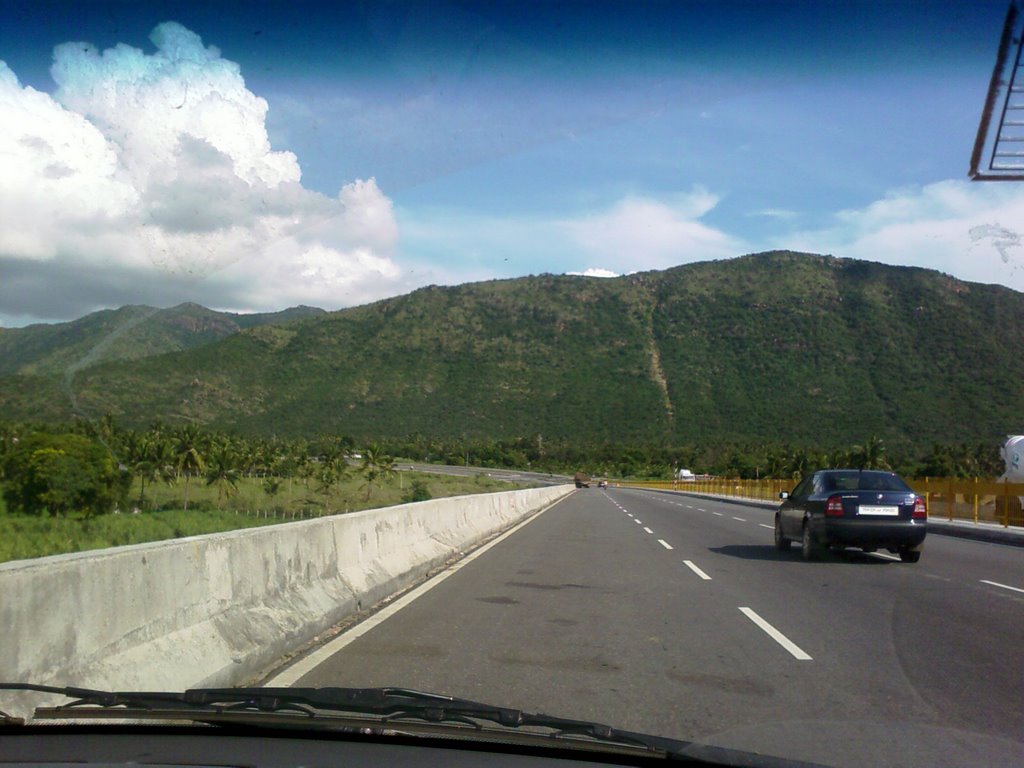
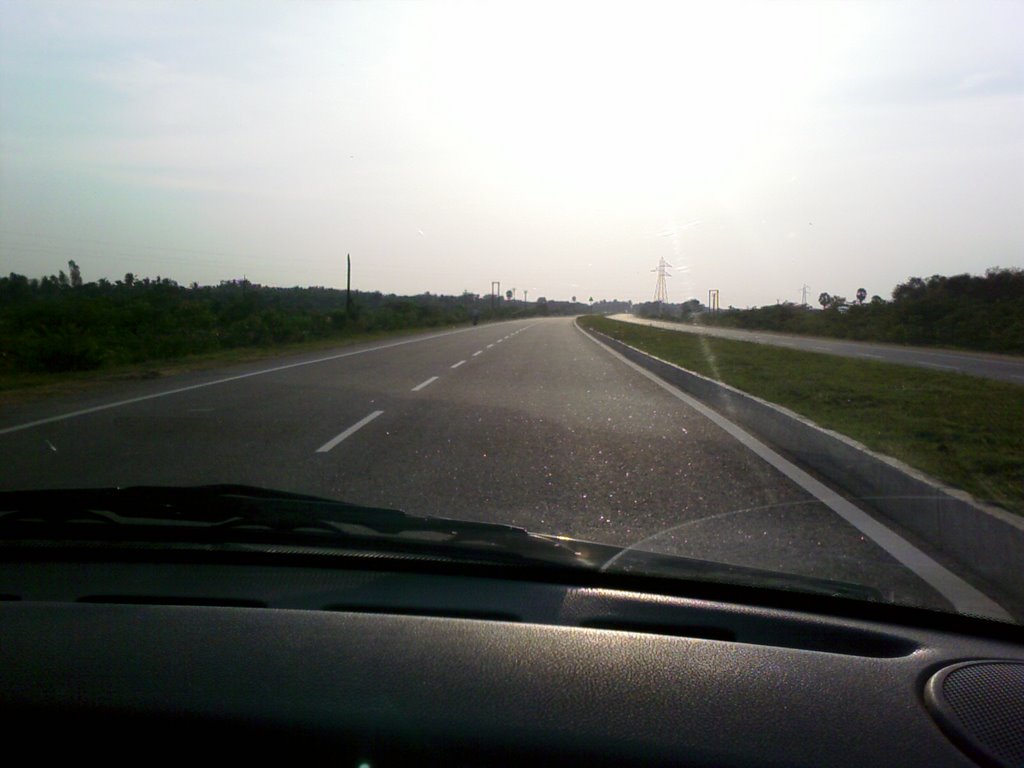
I drove down to bangalore the other day, and took the famed GQ... man, was i impressed. I was able to do a steady 90, even while passing thru villages. However, true desi style, you had maniacs driving on the wrong side, and glaring at you like your at fault!
Friday, October 06, 2006
M & A
classification of growth has lead to a very generic macro level perspective that can be compartmentalized as organic and inorganic. One where the company grows through its hard work and push, thereby improving systems within, and products leads to better profits and share value thereby a bigger market cap. This, I feel is a good way of growing, simply due to the fact that the possibility of learning during the process. This is much slower and has its own loopholes and downfalls, there by making this route to growth sometimes a harder path to take.
Another interesting path that is taken by many is the "inorganic" path. This mainly encompasses the M&A route that leads to a larger organization with a better market cap. However, mixing oil and water cannot happen by just mixing them, you need to add emulsified agents, or blend them in, like with mayonnaise. The acquiring company generally looks for a company that either compliments or supplements its existing talent pool thereby enabling itself to move into a relatively new market, or a new product or a another competitor. In essence, any M&A activity involves changing the 4Ps and creating a new set of 4Ps that are different from the company's existing ones.
So how does an M&A activity help a company? Well, like the points mentioned above:
1. The company sees great scope in a particular market, however, it does not posses the necessary talent or technology to enter this market, hence it decide to acquire a company that is doing well in this market for the same.
2. The company needs to grow to show that it is doing well, I call it the ford route, acquire other companies that will help add to your product portfolio and say very boldly to the world that my product portfolio has increased hence I am dong well.
there are many more reasons why M&A activities take place, but this is not the reason of this post. Many a time, actually majority of times the merger fails to take off, due to cultural or other factors, some notably good ones that lost value for the share holder rather than gained value are he AOL-time Warner merger, Daimler Chrysler,etc. etc
However, a symbiotic relationship need not necessarily exist purely through a merger or an acquisition. There are MoUs that can be signed by companies such that they can work with each other to help provide better services to their customers.
Cashnet, a common atm switch built for Indian banks is one such example where consolidation of infrastructure has worked well to better the customer experience. Cashnet is in direct competition to VISA/Maestro's switching and backbone networks, however, with the interconnect fees being charged per transaction, the possibility of moving customers from counter banking to ATM banking would have been tough with this as a deterrent. The average cost of servicing a customer at the branch works out to about Rs.200/- per transaction as opposed to Rs.20/- at the ATM and about 0.40P via the internet. Hence, embracing technology is a good way forward for the bank thereby allowing them to be able to spread their reach and improve the customer touch points.
Consolidation in t he banking industry has seen a string of mergers between banks and other institutes. The ICICI merger along with ICICI bank to result in a single entity, the same with HDFC and TimesBank resulting in HDFC bank, Global trust bank etc. This can be seen as a path forward to many banks.
Like with setting up any infrastructure, the costs involved are rather high, and the returns need not necessarily offset the investment. The greatest risk is the fact that a large percentage of the income is from interests generated via lending. India has the highest percentage of vehicles bought on loans. The worldwide average is about 70% vis a vis 80% in India.
The ability of the treasury in the bank to be able to roll the customers savings profitably is the key to survival of the banks. Hence, areas where the bank can save on infrastructure costs it will either outsource or work with other banks. In the case that the bank has decided to go on its own, eventually might lead to its collapse, and its assets being picked up by another bank.
The banking scene is fraught with trends of Mergers or acquisition or understandings within the community in order to survive against the big fish.
Another interesting path that is taken by many is the "inorganic" path. This mainly encompasses the M&A route that leads to a larger organization with a better market cap. However, mixing oil and water cannot happen by just mixing them, you need to add emulsified agents, or blend them in, like with mayonnaise. The acquiring company generally looks for a company that either compliments or supplements its existing talent pool thereby enabling itself to move into a relatively new market, or a new product or a another competitor. In essence, any M&A activity involves changing the 4Ps and creating a new set of 4Ps that are different from the company's existing ones.
So how does an M&A activity help a company? Well, like the points mentioned above:
1. The company sees great scope in a particular market, however, it does not posses the necessary talent or technology to enter this market, hence it decide to acquire a company that is doing well in this market for the same.
2. The company needs to grow to show that it is doing well, I call it the ford route, acquire other companies that will help add to your product portfolio and say very boldly to the world that my product portfolio has increased hence I am dong well.
there are many more reasons why M&A activities take place, but this is not the reason of this post. Many a time, actually majority of times the merger fails to take off, due to cultural or other factors, some notably good ones that lost value for the share holder rather than gained value are he AOL-time Warner merger, Daimler Chrysler,etc. etc
However, a symbiotic relationship need not necessarily exist purely through a merger or an acquisition. There are MoUs that can be signed by companies such that they can work with each other to help provide better services to their customers.
Cashnet, a common atm switch built for Indian banks is one such example where consolidation of infrastructure has worked well to better the customer experience. Cashnet is in direct competition to VISA/Maestro's switching and backbone networks, however, with the interconnect fees being charged per transaction, the possibility of moving customers from counter banking to ATM banking would have been tough with this as a deterrent. The average cost of servicing a customer at the branch works out to about Rs.200/- per transaction as opposed to Rs.20/- at the ATM and about 0.40P via the internet. Hence, embracing technology is a good way forward for the bank thereby allowing them to be able to spread their reach and improve the customer touch points.
Consolidation in t he banking industry has seen a string of mergers between banks and other institutes. The ICICI merger along with ICICI bank to result in a single entity, the same with HDFC and TimesBank resulting in HDFC bank, Global trust bank etc. This can be seen as a path forward to many banks.
Like with setting up any infrastructure, the costs involved are rather high, and the returns need not necessarily offset the investment. The greatest risk is the fact that a large percentage of the income is from interests generated via lending. India has the highest percentage of vehicles bought on loans. The worldwide average is about 70% vis a vis 80% in India.
The ability of the treasury in the bank to be able to roll the customers savings profitably is the key to survival of the banks. Hence, areas where the bank can save on infrastructure costs it will either outsource or work with other banks. In the case that the bank has decided to go on its own, eventually might lead to its collapse, and its assets being picked up by another bank.
The banking scene is fraught with trends of Mergers or acquisition or understandings within the community in order to survive against the big fish.
Wednesday, October 04, 2006
a song!
I stand at the door,
wondering where i need to go,
my life is ahead of me,
like a book, with empty pages.
waiting for me to write,
about, me, my love and my life.
now how i choose to write that,
it is all up to me,
cause my life is in my hands,
to be what i want to be.
I stand at the door,
wondering where she is,
looking for the light,
feeling a sense of pride,
now, why should it affect me?
the five words, L,O, V E
Now How i choose to write that,
it is all up to me,
cause my life is in my hands,
to be all i want to be.
---- Guitar Solo-----
the door closes,
i am neither in nor out,
wondering why i have to be,
in so much of doubt,
i see the light,
i see the dark,
i see the love,
as bright as a spark,
i wonder what holds me,
no matter how hard i try,
its all up to me now,
to live my life,
now how i choose to write tht,
it is all up to me,
cause my life is in my hands,
to be all i want to be.
wondering where i need to go,
my life is ahead of me,
like a book, with empty pages.
waiting for me to write,
about, me, my love and my life.
now how i choose to write that,
it is all up to me,
cause my life is in my hands,
to be what i want to be.
I stand at the door,
wondering where she is,
looking for the light,
feeling a sense of pride,
now, why should it affect me?
the five words, L,O, V E
Now How i choose to write that,
it is all up to me,
cause my life is in my hands,
to be all i want to be.
---- Guitar Solo-----
the door closes,
i am neither in nor out,
wondering why i have to be,
in so much of doubt,
i see the light,
i see the dark,
i see the love,
as bright as a spark,
i wonder what holds me,
no matter how hard i try,
its all up to me now,
to live my life,
now how i choose to write tht,
it is all up to me,
cause my life is in my hands,
to be all i want to be.
Thursday, September 28, 2006
My new torch!
Well, I could not think of a better title, because i just wanted to pen down some of my thoughts, and my torch, which incedently is new, was lying next to me, hence the title.
One of the things i personally belive de-motivates anyone beyond measure is the lack of any acknowledgement from people involved. i put in a lot of effort into something that i did sometime ago, but hoewver, acknowledgement has never been attributed to me, but to some others, sometimes, i wonder why this happens. is it that its an oversight? but i guess what upsets more is that someone who does nthing gets acknowledged as having contributed, thats even more depressing.
sigh!!1 i guess i have to just live with this kind of stuff all the time!!!
One of the things i personally belive de-motivates anyone beyond measure is the lack of any acknowledgement from people involved. i put in a lot of effort into something that i did sometime ago, but hoewver, acknowledgement has never been attributed to me, but to some others, sometimes, i wonder why this happens. is it that its an oversight? but i guess what upsets more is that someone who does nthing gets acknowledged as having contributed, thats even more depressing.
sigh!!1 i guess i have to just live with this kind of stuff all the time!!!
The latest competitive edge!
in todays world: what is the single point that provides the competitive edge? Technology: there has been a steady move from man, to machine to microchips.
from the industrial revolution, there has been the constant urge to find ways of doing things, better, faster and cheaper, thats what makes the company do better, and thats what sells. The horse drawn carriage was replaced by a motorised carriage (even though in some states in india, there are still ox drawn carriages, thats a generation behind the horse drawn ones), the hand made motor carriage was replaced by the assembly line, the assembly line was perfected to JIT, and that has provided for cheaper faster cars. now a company that first had gotten itself lovely sales persons who could talk the hind legs off a donkey, and also sell sand to the arabs at the same time. later, there was the inkling that the things were not going as planned, so they turned towards technology to get and track the customers needs, wants & desires. that worked really well, then everyone got into doing just that. Jaguar did that rather successfully, wherein, they used technology to track their customer service requirements, and this has become an industry standard. Jaguar worked hand in hand with Peppers & Rogers group to come out with a customer relationship mgt suite that helps track the usage, and based on the customers driving patterns informs the customer about service frequencies etc. this worked well, because it provide for a "personalised" attention to each customer. From what i heard, lexus goes one level further with technology. Each car owner's specifications are taken into account, and once the internal adjustments for the car are made, they are embedded intot eh key that is handed over, that includes seat height, airconditioning, music system volume etc etc, so when the car is opened with a particular key, the adjustments are made for the driver to get in. That is clearly a competitive edge using technology.
However, technology can be replicated, so what is it that the company needs to stay in front? Using technology to enable business, not using technology for business. Using technology to enable business is to be able to leaverage on cutting edge technology to offer better services to its customers. The market is moving from a manufacturing economy to a service economy. World over, it is the services that play an impact. Even in a manufcaturing company, the services angle plays an important role in deciding the buying decisions of the customer. Hence, any company, wishing to stay ahead of competition, should use technology to enable its employees to work better.
Unified communications platforms,VoIPs, MPLS, MoIP etc are all new age technologies that are coming into the market. ompanies that are able to implement them will definitly be able to push ahead of competition.
On example of leveraging on technology, a food service company was able to reduce response times from 24hrs to 15 mins due to implementation of CISCO's Unified communcations platform. Another IT service company was able to shave 20% off its data communcation costs due to its migration to an MPLS network.
So, now that we know that technology is here to stay, we should allow ourselves to leverage on it to enable businesses.
That is the latest competitive edge!
from the industrial revolution, there has been the constant urge to find ways of doing things, better, faster and cheaper, thats what makes the company do better, and thats what sells. The horse drawn carriage was replaced by a motorised carriage (even though in some states in india, there are still ox drawn carriages, thats a generation behind the horse drawn ones), the hand made motor carriage was replaced by the assembly line, the assembly line was perfected to JIT, and that has provided for cheaper faster cars. now a company that first had gotten itself lovely sales persons who could talk the hind legs off a donkey, and also sell sand to the arabs at the same time. later, there was the inkling that the things were not going as planned, so they turned towards technology to get and track the customers needs, wants & desires. that worked really well, then everyone got into doing just that. Jaguar did that rather successfully, wherein, they used technology to track their customer service requirements, and this has become an industry standard. Jaguar worked hand in hand with Peppers & Rogers group to come out with a customer relationship mgt suite that helps track the usage, and based on the customers driving patterns informs the customer about service frequencies etc. this worked well, because it provide for a "personalised" attention to each customer. From what i heard, lexus goes one level further with technology. Each car owner's specifications are taken into account, and once the internal adjustments for the car are made, they are embedded intot eh key that is handed over, that includes seat height, airconditioning, music system volume etc etc, so when the car is opened with a particular key, the adjustments are made for the driver to get in. That is clearly a competitive edge using technology.
However, technology can be replicated, so what is it that the company needs to stay in front? Using technology to enable business, not using technology for business. Using technology to enable business is to be able to leaverage on cutting edge technology to offer better services to its customers. The market is moving from a manufacturing economy to a service economy. World over, it is the services that play an impact. Even in a manufcaturing company, the services angle plays an important role in deciding the buying decisions of the customer. Hence, any company, wishing to stay ahead of competition, should use technology to enable its employees to work better.
Unified communications platforms,VoIPs, MPLS, MoIP etc are all new age technologies that are coming into the market. ompanies that are able to implement them will definitly be able to push ahead of competition.
On example of leveraging on technology, a food service company was able to reduce response times from 24hrs to 15 mins due to implementation of CISCO's Unified communcations platform. Another IT service company was able to shave 20% off its data communcation costs due to its migration to an MPLS network.
So, now that we know that technology is here to stay, we should allow ourselves to leverage on it to enable businesses.
That is the latest competitive edge!
Monday, September 25, 2006
Sunday, September 24, 2006
My first long distance trip!
Well, there is this group of cycling enthusiasts, whom i had gotten to know of, yesterday, they were planning on taking a trip to the north of the city. i thought, hmmm. maybe i will take a ride, meet up with them and head back, so i went to meet them, and the idea of actually peddling a bout 65 Kms did sound fun, it was that inbetween place, neither too far, nor too close! so we took off. It turned out to be a very interesting ride. the sights, the sounds. The pain of cycling really got to me by the end of the trip, i was a pile of aches. That did feel rather bad, cause the others seem to have been in good health! :( so now i have something to work towads, i think i must get a better seat on my cycle, i think that will help! :)
anyways, i decided that if i comeback and give into my aching joints, i might not be able to get up, so i bravely put up a front and head out to finish errands! i finally go to sleep rather early, and then wake up in the mornig with a phenomenal back ache! something that does not hurt, is hurting now! :( aarrggh! got to get back in shape!
anyways, i decided that if i comeback and give into my aching joints, i might not be able to get up, so i bravely put up a front and head out to finish errands! i finally go to sleep rather early, and then wake up in the mornig with a phenomenal back ache! something that does not hurt, is hurting now! :( aarrggh! got to get back in shape!
Subscribe to:
Posts (Atom)


 Posts
Posts


